

⏱️ This article takes about 6 minutes to read.
I still remember the day I started living with a cat.
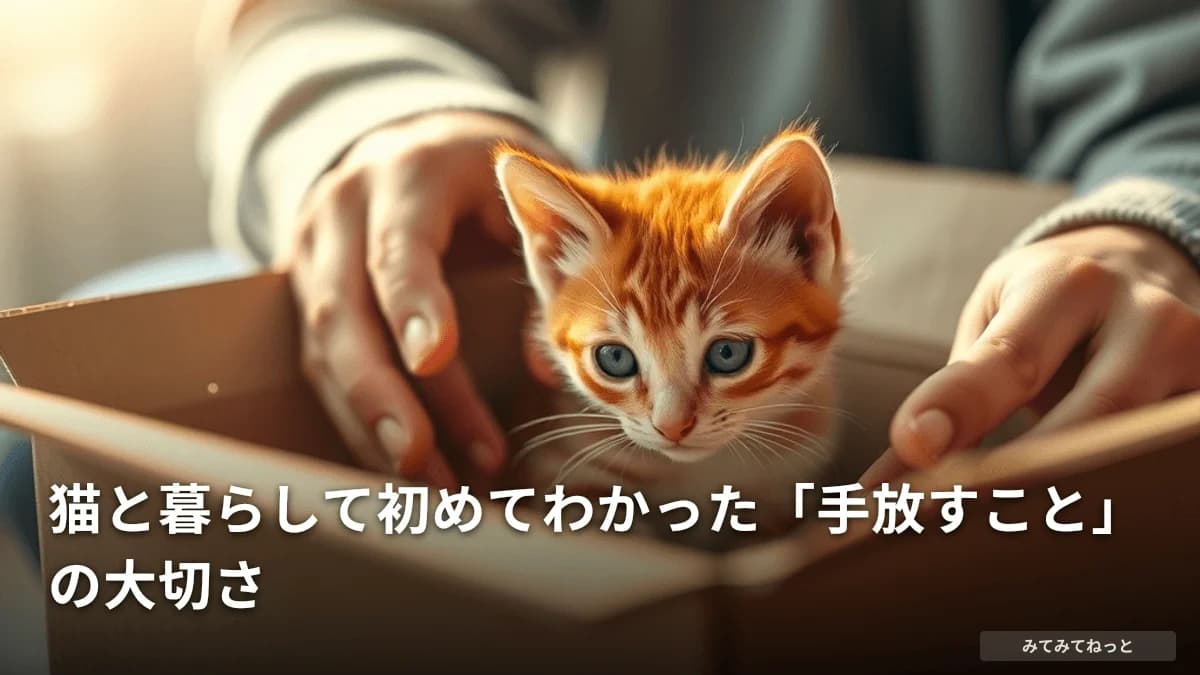
A three-month-old brown tabby that poked its face out through the gap in a cardboard box. Its name was Mugi. In that moment, for some reason, I felt something like a sense of mission: "I absolutely have to make this little one happy." That was the beginning of everything—and also the starting point of a long journey in which I would, over a long stretch of time, learn how to "let go."
Me, Trying to Be the "Perfect Owner"
For a while after welcoming the cat, I was utterly desperate.
The amount of food, the play time, the room temperature, the cleanliness of the litter box. I gathered up every scrap of information about cats and chased after the "correct care." The moment Mugi seemed even slightly less energetic, I'd immediately look up the symptoms online, imagine the worst-case scenario, and spend sleepless nights.
One day, the vet gently pointed out, "You're being a little too nervous, you know." "Cats are creatures that can regulate themselves just fine. Try trusting her a bit more."
Honestly, at first I couldn't quite swallow those words. Trust her? But if something happens, it'll be too late. That's what I kept thinking.
How Mugi Taught Me to Let Go of Control
The turning point came around when Mugi was a little over eight months old.
One night, when I was curled up crying on the sofa—I'd hit a wall at work—Mugi quietly came over and climbed onto my lap. She didn't say anything, didn't make any show of comforting me. She was just there. Warm, a little heavy, breathing steadily.
In that moment, it suddenly hit me.
Mugi wanted nothing from me. I didn't need to be a perfect owner, didn't need to always be smiling, didn't need to have the right answers. Just being there was enough. That was plenty—and the cat understood that perfectly well.
For so long, I'd lived under the compulsive belief that I "had to be doing something." At work, in my relationships, and in my life with the cat too. But Mugi never once blamed me for it. She simply accepted things as they were.
Watching her, I felt like I understood for the first time what "letting go" meant—not in my head, but in my body.
Cats Are Masters of "This Very Moment"
When you observe cats, you realize just how much they live in the "now."
Mugi doesn't dwell on yesterday. Even if I couldn't play with her the day before, the next morning she'll come rubbing up against me with a "good morning," as if nothing happened. Even when something unpleasant occurs, a few minutes later she's already fast asleep in a sunny spot.
What about us humans? We chew over past failures again and again, worry about a future that hasn't even arrived—how much are we really living in the time called "now"?
Whenever I failed at work, it wouldn't leave my head for days. "If only I'd made a different choice back then," "What's going to happen from here?"—I'd get stuck in that loop of thoughts, just wearing away the time right in front of me.
But watching the way Mugi lives, I'm reminded of the richness of focusing on "what is here, right now." The light streaming through the window, the curtain swaying in the breeze, the smell of dinner. For a cat, that alone is more than enough to fill the world.
"Letting go" might mean gradually loosening our attachment to the past and our anxiety about the future.
I Came to Know That "Things Not Going as Planned"
Is Just Normal
Until I had a cat, I somewhere believed in the feeling that "if you try hard, things will go the way you want."
But cats shatter that illusion with such lightness.
They prefer a cardboard box to an expensive toy. They prefer the pile of my clothes to the bed I went to the trouble of setting up. They run away when you try to pick them up, yet climb onto your lap the moment you ignore them.
At first I was constantly thrown off, thinking "Why?!" as Mugi ran me around. But at some point I came to think, "Well, that's just how it is." Rather than lamenting that things don't go your way, it's far more fun to find the amusement within things not going your way.
This was the same in human relationships.
A partner, friends, people at work. Whenever you try to force someone into the mold of "I wish you were like this," friction is sure to arise. But when you accept that person, whole, for who they are, the relationship suddenly grows lighter. That's what Mugi taught me.
What Remains After You Let Go
When you hear "let go," you might picture losing something.
But what I realized from living with a cat is that it's precisely after letting go that the important things remain.
When I let go of the anxiety that I "had to be a perfect owner," my time with Mugi became simply calm and dear. When I let go of the strain of trying to control everything, I naturally became able to read the cat's feelings. When I let go of regret over the past and worry about the future, Mugi's sleeping face today looked unbelievably adorable.
Letting go isn't giving up. I think it's creating room—space to connect with something more essential.
Mugi is dozing by the window again today.
No matter what I'm thinking, no matter what's troubling me, it makes no difference to her. She's just there, warm, and alive.
Every time I see her like that, the tension in my shoulders eases just a little. "Ah, right—I don't have to try so hard," I can think.
Cats have no words. And yet, every single day, they teach me far more than words ever could.
If you, too, are worn out from carrying too much, there's one thing I'd like you to try just once, like a cat.
Today, just let go of one thing.
You don't have to come up with the right answer. You don't have to be perfect. Things don't have to go your way.
Because the moment you let go of that one thing, something you couldn't see before will surely come into view.