
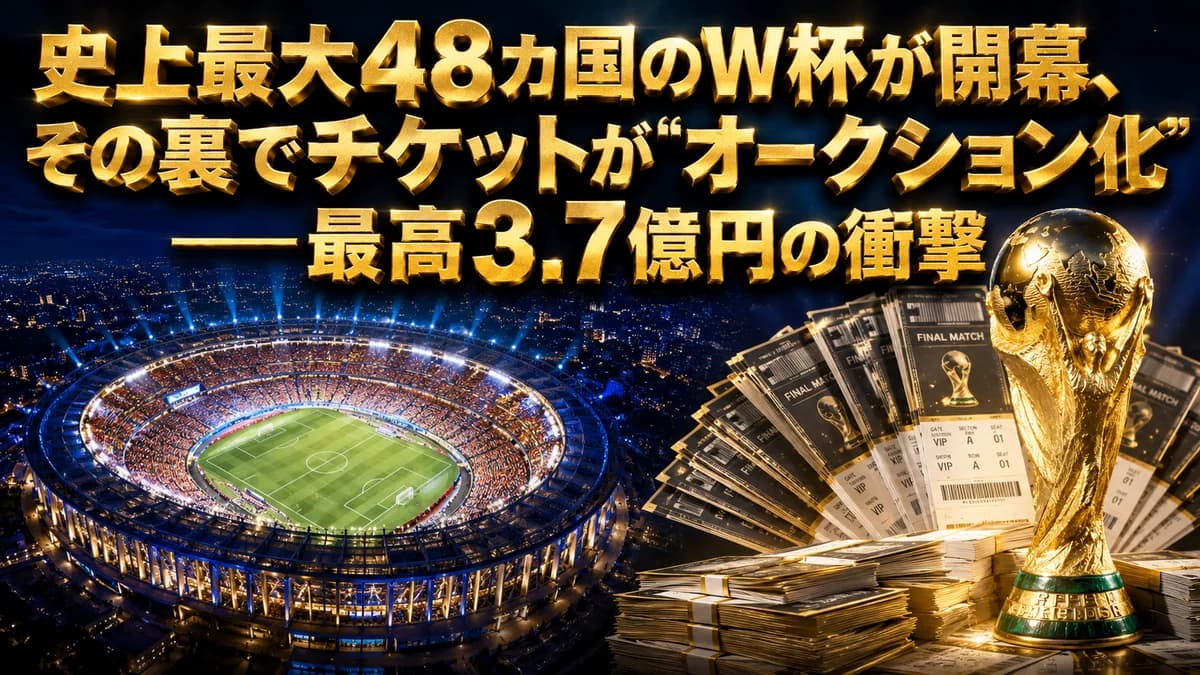

On June 11, 2026, the soccer World Cup kicked off, co-hosted by the three nations of the United States, Canada, and Mexico. The number of participating countries jumped from 32 last time to 48 all at once, while the number of matches (104) and the tournament length (39 days) are all the largest in the event's history. The global audience is projected to reach a cumulative 6 billion viewers — roughly three-quarters of the world's population — and a truly "planet-scale festival" has begun.
But behind the excitement on the pitch, what is causing the biggest stir among fans worldwide right now is not the scores. It is ticket prices. With the "dynamic pricing" system that FIFA (the International Federation of Association Football) introduced for the first time at this tournament, together with the existence of an official resale site, tickets are no longer something you "buy" but something you "bid on" — taking on, in other words, the look of an auction. In this article, we first lay out the expanded structure of the tournament, and then look at the full picture of the overheating ticket problem.
The Largest Ever: A New Tournament Structure of 48 Nations and 104 Matches
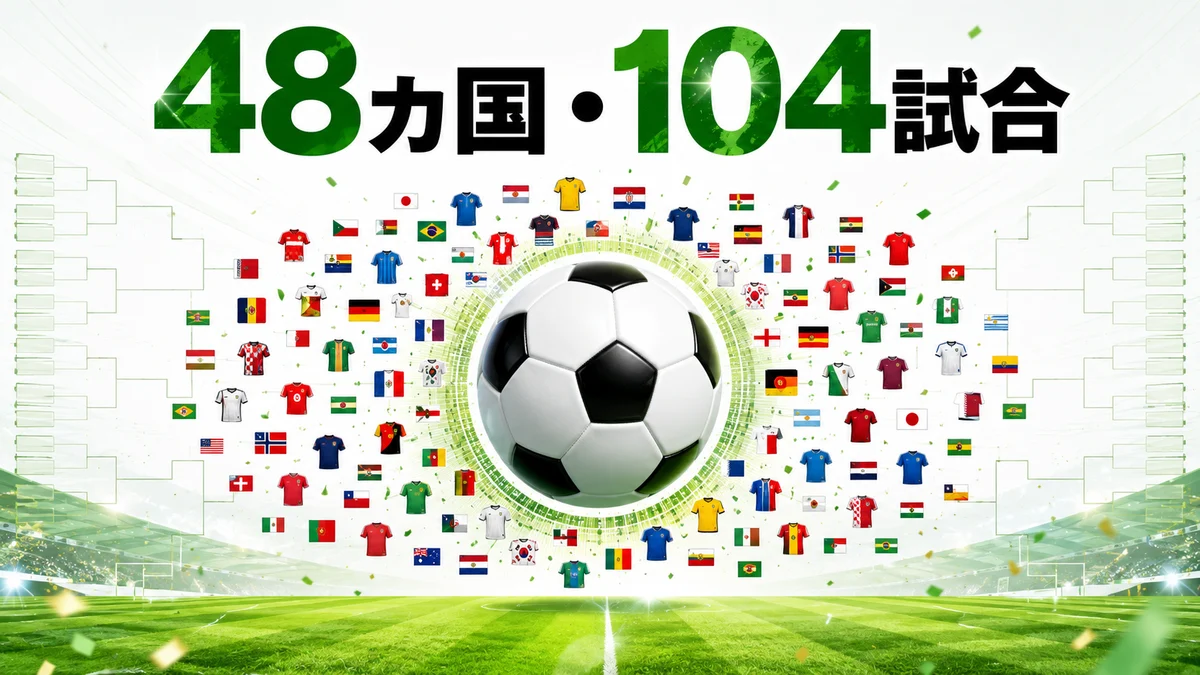
The biggest feature of this tournament is, above all, that the number of participating countries has grown to 48 nations. This has greatly reworked the very framework of the tournament.
The 48 nations are divided into 12 groups of four teams each, and they first play a round-robin group stage (the first-round league). The group stage alone amounts to 72 matches.
The advancement system is new as well. The top two teams in each group (24 teams in total) automatically advance to the knockout tournament, and "the eight best-performing third-place teams" are added, forming a knockout tournament of 32 teams in total. In other words, from this tournament a new knockout stage called the "Round of 32 (the best 32)," which did not exist before, has been established. From there, the familiar single-elimination matches continue: the Round of 16, the quarterfinals, the semifinals, and the final. The knockout tournament alone is 32 matches, which together with the group stage works out to 104 matches.
As for the schedule, the group stage runs from June 11 to 27. The newly created Round of 32 runs from June 28 to July 3, and the final takes place on July 19. The stage for the opening match is the legendary stadium in Mexico City, Estadio Azteca. The final will be held at MetLife Stadium in New Jersey, USA (tournament name "New York New Jersey Stadium"). The venues spread across 16 cities in three countries, and both players and fans will compete while moving across the vast North American continent — an unprecedented, dispersed format.
The impact of venues straddling three countries is no small matter. Within the United States alone there is a three-hour time difference from the East Coast to the West Coast, and including Mexico and Canada, some teams will repeat moves on the order of thousands of kilometers. The climate, too, varies — from the searing heat of the American South in midsummer to the relatively cool conditions of Canada. Which city a team makes its "home base" for the group stage could sway wins and losses in terms of condition management. The larger the scale, the more this becomes a tournament in which the skill of off-pitch "logistics" (travel, lodging, adjustments) ties directly to results.
For teams, with the slots expanded to 48 nations, a chance has now come around even to countries that had never been able to reach the World Cup. Japan secured its place early, and with the increase in Asian slots, the road to the main tournament has widened slightly. On the other hand, because the number of matches has surged, winning the title requires getting through up to eight matches, and the congested schedule and heavy travel burden on players have already become a topic of debate. The expansion of scale "widens the doorway of dreams" while, at the same time, bringing along "harshness."
The Pros and Cons of Expansion
The shift to 48 nations has been accompanied by pros and cons from the start. Supporters welcome it, saying, "The main-tournament stage opens up to countries in Africa, Asia, and North and Central America that have shed tears in qualifying until now," and "soccer's grass roots spread around the world." In fact, this tournament includes several first-time participants, a historic moment for each of those countries.
On the other hand, the cautious point out that "with the groups subdivided into 12, the number of dead-rubber matches (matches that do not affect the standings) may increase," and "there is concern that the gap in strength between powerhouses and emerging nations is too wide, increasing the number of lopsided matches." Furthermore, some say that the new rule under which some third-place teams advance makes it hard to determine until the final match "what rank we need to be to qualify," creating confusion. Widening the doorway and maintaining the tension of the tournament as a whole — squaring these two will actually be put to the test at this tournament.
Meanwhile — Tickets Are Going "Up for Auction"
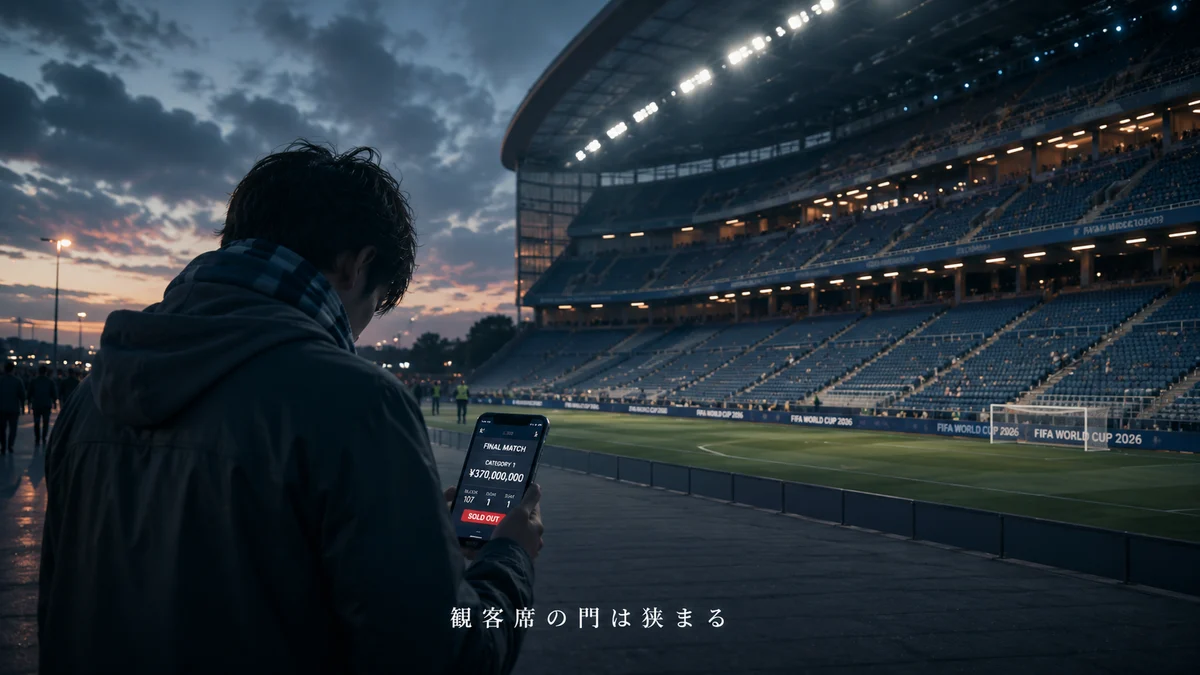
At this largest-ever tournament, another first-ever attempt was introduced. It is dynamic pricing for tickets. Like airfares and hotels, this is a system in which the price rises when demand goes up and falls when demand drops. For FIFA to scrap its fixed price list and move prices in line with market demand was a first in World Cup history.
The price range FIFA initially presented started at $60 (about 9,600 yen) for the cheapest group-stage tickets. Looking at just that, some people probably felt it was "surprisingly affordable." However, the upper limit was set at $6,730 (about 1 million yen) for the final, and even that was no more than a "starting point."
Once it could read demand, FIFA raised prices sharply at once. According to reports, as of late May, the top-category seats for the final had jumped, at the primary-sales stage, to $33,970 (over 5 million yen) — several times the initial upper limit. The minimum price for a final ticket also reached $4,185 (about 650,000 yen), which is roughly seven times the minimum final price at the 2022 Qatar tournament ($602). "Dynamic pricing," put plainly, was also a system in which "popular matches become unlimitedly expensive."
An Official Resale Site as the "Auction Floor"
Adding fuel to the price surge is the official ticket resale site that FIFA opened on October 2, 2025. It is a mechanism by which fans can buy and sell tickets they have already purchased among themselves. On the surface it is a sound matchmaking that "connects those who can no longer go with those who absolutely want to go," but the problem lies in its pricing.
For matches held in the US and Canada, no upper limit is set on resale prices. In other words, sellers can put on whatever price they like. For popular fixtures where demand has exploded, this has turned into a de facto auction floor. In April 2026, a ticket with an outrageous price of $2.3 million (over 370 million yen) was listed on the official resale site, sending a shock around the world.
What also cannot be overlooked is the structure in which FIFA itself profits from this resale. When a resale goes through, FIFA collects a fee of about 15% each from the seller and the buyer — about 30% combined. Had the aforementioned 370-million-yen ticket sold, FIFA would, by calculation, have pocketed $690,000 (over 110 million yen) in fees alone. The higher the price is driven, the more the organizer profits — this conflict-of-interest structure has drawn concentrated criticism.
Rising "Fake Ticket"
Risk in the Shadow of the Surge
When prices soar, fraud invariably follows. As people who cannot afford official channels flow to unofficial transactions "to get it even a little cheaper," cases of counterfeit tickets and of "paying the money and never receiving the ticket" have been reported around the world. One of FIFA's aims in preparing an official resale site was to bring under official control the black-market dealing and malicious high-priced reselling (scalping) that would otherwise occur.
Ironically, however, it cannot be denied that the official site itself permitted high-priced reselling with no upper limit and, as a result, became an "officially sanctioned auction." A mechanism meant to protect fans from fraud has also become a device that pushes prices even higher — here the difficulty of this tournament's ticket problem is distilled. For fans aiming to watch on-site from Japan, the cardinal rule of self-defense is to limit purchases strictly to FIFA's official channels (FIFA.com/tickets) and the official resale site, and to never reach for "bargain tickets" sold on social media or through private transactions.
"Even I Wouldn't Pay"
— Spreading Backlash and Concerns over Empty Seats
The surge has been so extreme that the criticism is not limited to fans and experts. It was even reported that US President Trump dismissed the high-priced tickets, saying, "Even I wouldn't pay" that. For people who have believed soccer to be "a sport of ordinary people," a price at which a single final ticket could buy a house or a car is by now a story from another world.
Ironically, the aggressive pricing has also produced "unsold inventory." As of early June, tens of thousands of unsold tickets reportedly remained on FIFA's official site, and about 175,000 remained listed on the official resale site as well. While popular fixtures fetch prices in the hundreds of millions of yen, low-profile fixtures and overly expensive seats stay empty — a polarization is occurring. Caught between the tournament's ideal image of "a packed stadium" and the reality of its pricing, FIFA entered the opening with this friction still unresolved.
Summary: The Largest Scale, the Highest Hurdles
The 2026 World Cup, with its "wide doorway" of 48 nations and 104 matches, has opened its doors to more countries and fans than ever before. With the newly created Round of 32 and the dispersed hosting across 16 cities in three countries, the structure itself steps into a new era.
But at the same time, dynamic ticket pricing and uncapped official resale have raised the most basic hurdle to participation — "going to watch" — to an unprecedented height. The door for participating nations has widened, yet the door to the spectator stands is narrowing toward a wealthy few — this tournament confronts the world with such a contradiction.
In the background is the enormous money the World Cup generates. Revenue from broadcasting rights, sponsors, and tickets combined continues to set records every tournament, and for FIFA, tickets are at once "a service for fans" and an object of revenue maximization. Both dynamic pricing and uncapped official resale are, in the end, products of the commercial rationality of "taking as much as possible from those who can pay." The problem is that this rationality collides head-on with the fundamental question of "whose game is soccer?"
The frenzy on the pitch and the overheating of the ticket market. The 2026 World Cup, where these two "largest scales" coexist, looks set to be a symbolic tournament that augurs where the sport of soccer is heading next. Until the whistle of the final on July 19, we cannot take our eyes off the debate over tickets, as well as the course of the ball.
References: Goal.com, Politifact, Quartz, Al Jazeera, NBC Sports, Bunshun Online (Yahoo! News), and others