
One morning, as I was running my usual razor across my face at the bathroom sink, a thought struck me: "Couldn't these five minutes be just a little shorter?"
For nearly 20 years, shaving meant one thing and one thing only: a wet razor. Lathering up the shaving foam, steaming the skin, gliding the blade carefully across my face—I never actually disliked that whole ritual. If anything, I treasured it as the moment that flipped my morning switch on. On weekends I'd swap in a fresh blade and shave while checking how my skin was doing. I considered all that fuss to be part of grooming itself.
But once you pass your mid-40s, the story changes. Business trips pile up, mornings get hectic, and by evening my chin is already scratchy with stubble. It's not that my beard suddenly started growing faster, but once I realized that this stubble was the reason "my face looks worn out by evening," I couldn't ignore it anymore. The moments where I wished I could "quickly run the razor over it one more time" have been increasing year by year.
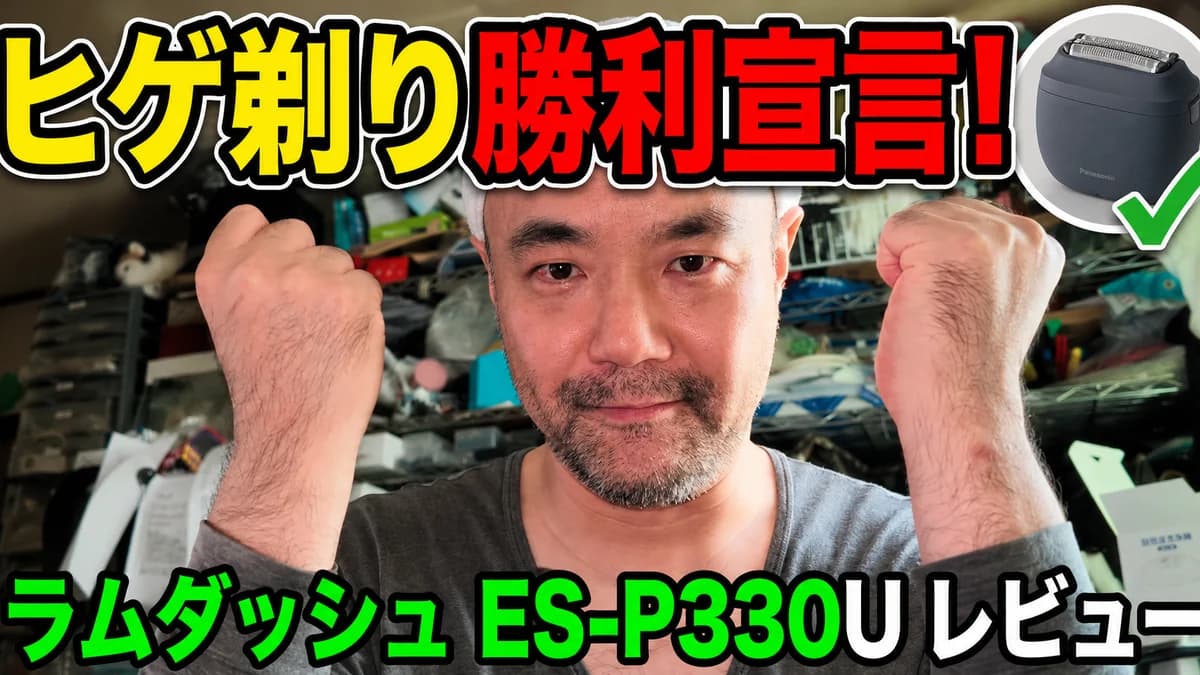
So I took the plunge and tried a palm-sized electric shaver. This time I'll share my switch-over experience, giving you my honest, unfiltered take. I hope it serves as a useful reference for anyone in their 40s wondering, "Maybe it's about time I went electric."
The Shock of Something the Size of a Rice Ball
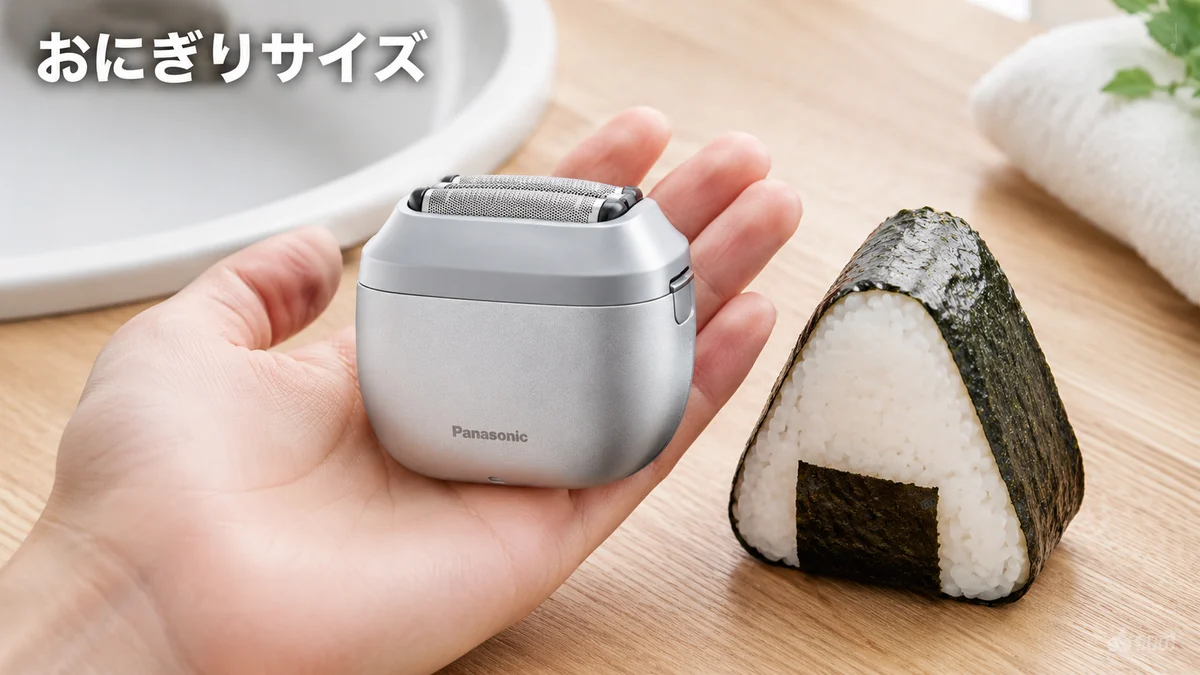
The first thing that surprised me when I opened the box was how small it was. To put it in terms of something familiar, it's about the size of an onigiri (a rice ball). It fits snugly in the palm of your hand.
When most people picture an electric shaver, they imagine that tall, vertical shape sitting on the bathroom counter. I was one of them. But this was an entirely different concept—you grip it in your hand and press it against your skin. At first I was so skeptical I genuinely wondered, "Can this thing really shave?"
Then there's the build quality. Because of my line of work involving manufacturing, I can't help but scrutinize the molding precision of plastic products and how the parts fit together—and this was superb. The cap snaps shut magnetically with a satisfying pull, and there's no cheapness in the seams between components. No burrs, no uneven coating. It's in these humble details that you feel what "Made in Japan" really means. Every time I pick it up, I sense the sincerity of the people who made it.
It charges via today's standard USB Type-C. Being able to use the same cable as my phone and laptop is a quietly welcome point for a frequent traveler. There's no need to carry a separate dedicated adapter, and just being able to cut one cable from my bag keeps things tidy. There's also the peace of mind that if I forget to charge it on the road, I can pick up a cable at any convenience store.
The "Compromise"
of a Three-Blade Model

What I chose this time wasn't the top-tier five-blade model, but a three-blade version that reduced the number of blades to keep the price down. The street price is around 20,000 yen. As electric shavers go, that's a price range where diving straight into the flagship model takes courage, so this "easy-to-try price" was an exquisite entry point.
Honestly, when it comes to a close shave, the wet razor wins. That exhilarating feeling of going perfectly smooth in a single pass is unique to a wet razor that presses the blade directly against the skin. With a three-blade electric shaver, you need to go back and forth over the same spot a few times, so the sense of speed is "a little leisurely." Areas like under the chin or along the neck, where the hair grows in complex directions, especially require careful re-application.
That said, you need to shift your mindset here. This isn't a "complete replacement for the wet razor"—it's "another option." If you accept that you're trading away the last few percent of closeness in exchange for gentleness on the skin and convenience, then choosing three blades actually makes perfect sense. For someone in their 40s whose skin tends to grow more sensitive, the reassurance of a blade that never directly touches the skin is surprisingly significant.
The "Time-Saving"
That Hits Home in Your 40s
What I appreciated most after switching was, above all, the convenience.
No lathering needed, no prep required. Turn it on, press it to your face, and shave. That's it. It even has a sensor that detects moisture, so you don't have to be too nervous about handling it at the sink. Just removing one step from your morning routine makes a real difference in your peace of mind.
And where this truly comes into its own is in the evening. Before an important dinner or meeting, you can quickly tidy up just around your mouth in the restroom. You can't do that with a wet razor. It's a feat only possible with an electric shaver that needs no foam, no sink, and no towel. A single quick pass in the evening tightens up the impression staring back at you in the mirror. This is a benefit I came to appreciate especially in my 40s.
The compactness shines on business trips too. You can toss it into your toiletry pouch without it getting in the way, and it's easy to handle even on a cramped hotel bathroom counter. If you really wanted to, you could discreetly tidy up on the bullet train or in the car. I felt it would also be a good idea to stash one in a desk drawer at the office as a "second electric shaver."
Blade replacement is needed about once every six months to a year, with replacement blades running around 5,000 yen. The running cost is by no means zero, but compared to a wet razor where you're buying new blades practically every month, it's not at a major disadvantage over the long run. If anything, the total may be comparable—or even cheaper depending on how you use it.
"The Joy of Ownership"
Isn't Bad Either
I've talked a lot about function, but one final point. This was a tool that lifts my mood just by owning it.
The texture that fits in your palm, the sensation of the magnet snapping into place, the clean design. Once you hit your 40s, you start to understand the value of a tool that's "a little delightful every time you use it," rather than purely practical. Rather than buying cheap things and replacing them one after another, you use a favorite one for a long time. A tool you can have that kind of relationship with raises the baseline of small daily satisfactions. And this was exactly one of those tools.
The "Getting Used to It"
I Felt in the First Week
To confess honestly, for the first two or three days of using it, I kept thinking, "Maybe the wet razor really is better after all." The lack of a close shave bothered me, and I'd unconsciously end up going back and forth more times.
But after about a week, I started to get the knack of how to apply it. Don't stand the blade up too steeply against the skin; move it slowly and in large strokes, going against the grain of the hair. I also discovered that it actually shaves better in the morning when the beard has grown out a bit. With any tool, the real battle is learning its quirks—I was reminded of that all over again.
The way it feels against the skin is also clearly gentler than a wet razor. Not only does it not draw blood, but there's almost no stinging afterward. Skin dryness and razor burn that didn't bother me when I was young start to quietly take their toll in your 40s. On that point, an electric shaver whose blade never touches the skin directly may be exactly suited to an age when you want to be kind to your skin.
Who It Suits, and Who It Doesn't
After using it for more than a week, the pros and cons of who it fits became clear.
People it suits
- Those who travel often and want a device that doesn't take up space
- Busy people who want to save time, morning and evening
- Those troubled by razor burn or skin irritation
- Those looking for a second device to keep at the office or gym
People it doesn't really suit
- Those who absolutely won't compromise on the smooth, close shave you get in a single pass
- Those who want to enjoy the "ritual" of morning shaving itself
In short, it comes down to what you prioritize most. For someone who, like me, can accept "convenience on weekdays, attention to detail on weekends," it should make an unbeatable partner.
Conclusion: Not One or the Other
In the end, I didn't throw away my wet razor. On weekend mornings, when I want to take my time for a thorough close shave, I use the wet razor. For busy weekdays, business trips, and evening touch-ups, the palm-sized shaver. I settled into this "use them for different purposes" arrangement.
- Prioritizing closeness and that refreshing feeling → wet razor
- Time-saving, portability, and evening touch-ups → compact electric shaver
How you view the 20,000-yen price tag is up to each person, but considering how the few minutes saved every morning and evening add up, it was a good buy as an investment in my 40-something self. You buy time, treat your skin kindly, and your mood gets a lift in the bargain. Looked at that way, it's by no means an expensive expenditure.
"Morning shaving has started to feel like a chore lately," "I'm bothered by how tired my face looks in the evening"—if you've started to feel that way, I think it's well worth trying out a convenient option like this once. Just by changing your tool, those few minutes of every day might come to be spent in a slightly better mood.