
Why the Mac mini M5 Is Selling Like Crazy — "The Optimal Answer for the AI Era"
Was Packed into a Tiny Box
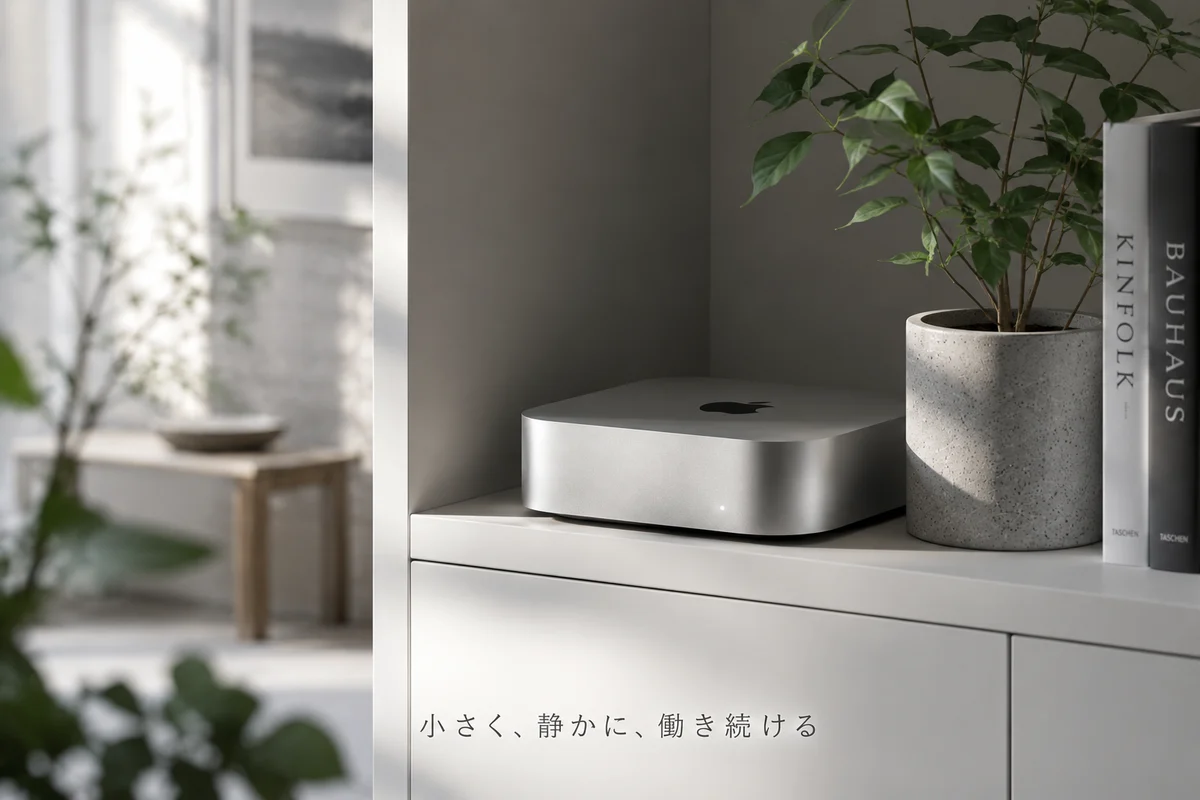
A tiny aluminum box small enough to rest on your palm. The price, too, is far more realistic than a high-end PC. And yet, the Mac mini has now become so popular that people say "buy one while you still can."
The latest-generation Mac mini M5, in particular, drew so much attention that shortages and shipping delays continued right after its announcement. Why does this seemingly plain desktop win such support?
The answer boils down to three keywords: "AI demand," "memory shortage," and "unified memory." In this article, we'll unravel — as plainly as possible — the "real reasons for its popularity" that you can't see from the spec sheet alone.
1. It All Started with the Explosion of "AI Demand"
What has changed the most in the past few years is the very way we "use our computers."
Until just a little while ago, AI for image generation and text generation was "something on the far side of the cloud." A giant AI like ChatGPT was running not on your own computer but on some enormous server far away — that was taken for granted.
Now, though, that flow is changing dramatically. The option of "running AI on the computer in your own hands (local AI)" has, all at once, become realistic.
- Running an image-generation AI locally and trying out any number of compositions you think of
- Running your own personal chat AI without connecting to the internet
- Completing video transcription, summarization, and translation right at hand
- Keeping a coding-assistant AI, your programming partner, resident locally
These uses are no longer the preserve of a handful of engineers. Creators, bloggers, researchers, students — the number of people who want to "put their own AI on their own desk" is increasing explosively.
And this "local AI boom" has rewritten the very criteria for choosing a computer. What matters now is not just "CPU speed," but "how large an AI you can run, and how comfortably."
Here, the Mac mini unexpectedly steps into a starring role.
2. The Biggest Bottleneck of the AI Era — the Wall of "Memory Shortage"
There's a wall that almost everyone who tries to run AI locally hits. It's "memory shortage."
The memory referred to here is not the often-heard "storage (saving capacity)." It's the part that's like AI's "workbench that it spreads out to think on right now" — what's called RAM or VRAM (video memory).
An AI model, to put it very roughly, is made of "a vast number of parameters (clumps of numbers)." To run it, you need to spread those clumps of numbers out entirely onto memory.
- A small AI model … runs with a few GB of memory
- A medium AI model … wants over a dozen GB or more
- A large AI model … won't even load without tens of GB of memory
In other words, "if memory is insufficient, that AI can't run, or it runs painfully slowly." This is the merciless rule of local AI.
Here, what many people run into is "a certain weakness" of typical gaming PCs and self-built PCs.
Adding a high-performance graphics board (GPU) makes AI faster. However, the VRAM (video memory) mounted on that GPU is often surprisingly small. Even an expensive high-end GPU doesn't carry as much VRAM as you'd expect, and on top of that, you can't add more later.
"There's plenty of memory on the CPU side, but the memory on the GPU side — the one that runs the AI — is fatally insufficient." This "fragmentation of memory" was precisely the sore point of conventional PCs.
And it's exactly this weakness that Apple silicon's "unified memory" overturns at the root.
3. The Heart of Its Popularity — the Invention of "Unified Memory"
This is the number-one star supporting the Mac mini M5's popularity. It gets a little technical, but once you grasp just this, "why it's selling" falls into place all at once.
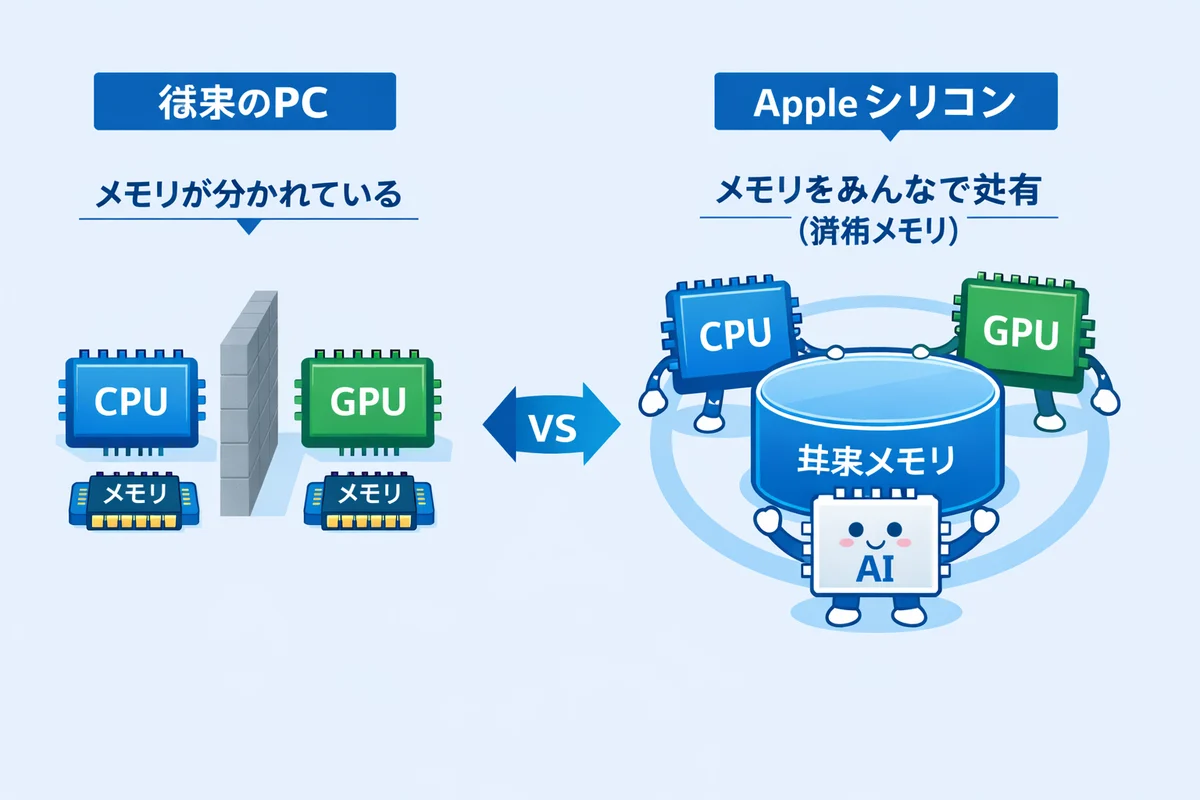
Conventional PCs: Memory Was "Split"
PCs until now were set up like this.
- Memory dedicated to the CPU (the brain)
- Memory dedicated to the GPU (in charge of video and AI) (VRAM)
These two were placed in separate locations, and every time data was exchanged, a "move" was deliberately required. On top of that, the GPU-side memory was small and couldn't be expanded. This is the true nature of the "memory shortage" mentioned earlier.
Apple Silicon: Memory Is "Shared by Everyone"
The design Apple adopted here is unified memory — literally "integrated / shared memory."
In the Mac mini M5, the CPU, the GPU, and other AI-dedicated processing units all share one large pool of memory amicably among themselves. There are no walls.
This proves frighteningly effective for AI use.
- Since no "moving" of memory is needed, there's no waste
- The GPU can use the entire memory mounted in the unit for AI
- If you choose a large-capacity memory, you can devote most of it to the AI model
For example, on an ordinary PC, "making VRAM alone tens of GB in order to load a huge AI" comes at a price detached from reality. But with the Mac mini, simply choosing a larger unified memory for the unit turns that capacity entirely into AI's "workbench."
"A tiny box, yet a large AI loads onto it." The true nature of this seemingly mysterious phenomenon was precisely unified memory.
4. Why "Mac mini"
— Not a MacBook, Not a Mac Studio
You might think, "Then wouldn't a MacBook do too?" or "What about the higher-end Mac Studio?" There are still solid reasons the Mac mini gets chosen.
(1) An exquisite balance of price and performance
Among Apple-silicon machines, the Mac mini sits in the "entry" price range. Even so, the insides are the same-generation chip and unified memory. As a first machine for someone who "wants to try touching AI locally," there's no better affordability.
(2) You can leave it on 24 hours a day
Many people who run AI want to "keep their computer running." Operating it continuously as a local AI server, running image generation all night long. The Mac mini has low power consumption and gentle heat output, so it keeps working quietly in the corner of your desk. It's far more reassuring than continually pushing a laptop to its limits.
(3) Small, quiet, space-saving
Palm-sized, with barely any operating noise. The fact that you can use the monitor and keyboard you already own as-is also lowers the hurdle for switching. Even as a "second machine for AI," it doesn't trouble you for a place to put it.
In short, the Mac mini M5 sits in a sweet position: "the box that lets you get the benefits of unified memory at the lowest price and most casually."
5. "Realistic Caveats"
Worth Knowing Before You Buy
We've lined up the good points so far, but to be fair, let us also share a few caveats.
Memory "can't be added later"
Because Apple silicon's memory is integrated with the unit, you can't add more after purchase. In other words, your memory-capacity choice at the time of buying decides everything. If you want to use AI properly, the iron rule is to choose "one step up" in memory within what your budget allows. Skimp here, and you won't be able to fully leverage the strength of unified memory.
Not the "peak speed" of a dedicated high-end GPU machine
For speed-focused uses where you "just want to generate even one image as fast as possible," there are situations where a PC with an expensive dedicated GPU has the edge. The Mac mini's strength is not the "limit of speed," but the overall balance of "a large model runs properly, with low power, quietly."
Compatibility with Windows-only software
If your main goal is tools or games that assume Windows, you need to carefully consider the very choice of a Mac. It's best to regard it as "a machine that shines for AI, creative, and server uses."
Summary — A Tiny Box Became "the Answer of the Era"
Let's organize, once more, the reasons the Mac mini M5 is selling.
- AI demand exploded, and the era of "running AI on your own computer" arrived
- The biggest wall to that was memory shortage
- Apple's unified memory broke that wall head-on
- And the box that lets you get those benefits most affordably was the Mac mini
It doesn't have the visual impact of a flashy gaming PC. But the Mac mini M5 is a machine that, to the question most people are agonizing over right now — "how to put AI in your own hands" — returns an answer quietly yet precisely.
A small aluminum box wins this much support. Behind that, there was a clear necessity of the era.
Note: This article is a general explanation of technology trends. For specific memory capacities and prices, please choose after checking the latest official information to match your use and budget.