

⏱️ This story takes about 9 minutes to read.
A Single Notification That Broke the Morning Silence
Right now, something almost unbelievable is unfolding in the world of AI and language processing.
From late 2024 into 2025, the evolution of large language models has been on the verge of erasing the barriers between human languages altogether. Google Translate supports more than 100 languages, and Meta's "SeamlessM4T" has made real-time speech translation a reality. As I scrolled through the news about these breakthroughs, a thought suddenly struck me.
"What comes next—cat language?"
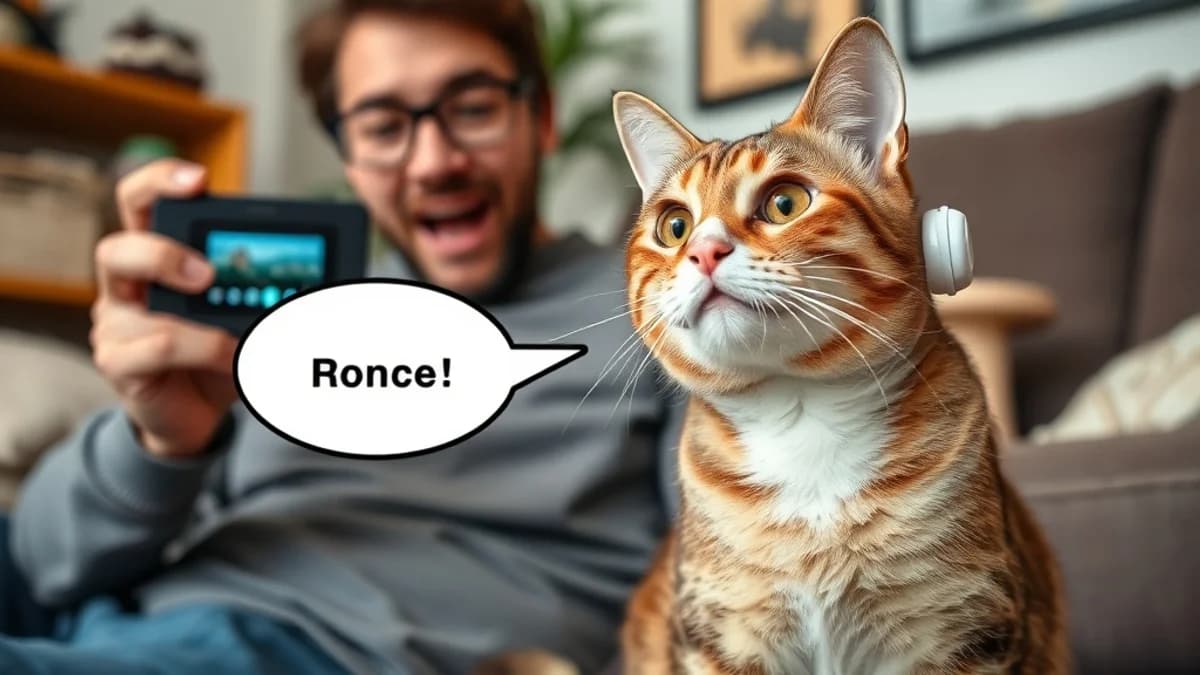
This is fiction, of course. But just imagine for a moment. If tomorrow your smartphone's translation app suddenly added a "cat language mode," what would you ask your beloved cat?
For me, the answer came instantly.
"Hey—do you like me?"
The Universal Translator "BABEL-∞"
Adds Cat Language Support
That morning, I—Sakura Tanaka, 32, a freelance web writer—was checking my smartphone while brewing my usual coffee.
A single room in an old apartment in Nakano Ward, Tokyo. In the six-tatami living room, a cat tower towered by the window, and there, curled up basking in the morning sun, was my calico cat, Mitarashi. Four years old, weighing 3.8 kilograms. When I found her, she was small enough to fit in the palm of my hand, yet now she carried herself with a dignified presence—the true ruler of this room.
A notification banner slid across the screen.
"[Important Update] BABEL-∞ ver.9.2.0 — New feature: Animal Language Mode (Beta). Now supports cat, dog, and bird languages."
I nearly spilled my coffee.
BABEL-∞ is a translation app developed in 2023 by the Silicon Valley startup "LinguaCore Inc.," and it currently supports 240 languages worldwide. It runs on a 980-yen monthly subscription, and I'd been using it nonstop for my reporting work. It rarely mistranslates, and its ability to read context is clearly more accurate than other apps.
But—cat language?
"It's just a beta. It's probably some kind of joke anyway."
Even as I thought that, my finger was already pressing the update button. Humans, after all, can never win against curiosity.
My First "Conversation"
With Mitarashi
During the two minutes it took for the update to finish, I stared intently at Mitarashi.
Mitarashi was, as always, gazing out the window. Her profile was as beautiful as a sculpture, her amber eyes sparkling in the morning light. For four years, I had cried and laughed beside this little one, groaning late into the night as deadlines loomed.
"What are you always thinking about, you?"
Even when I spoke to her, Mitarashi just glanced at me and turned her gaze back out the window.
The app launched.
The interface was simple, and in the language selection screen, a new item had appeared: "🐱 Cat Language (Beta)." When I read the instructions, they said:
"Turn on the microphone and record your cat's vocalizations. The AI comprehensively analyzes the sound patterns, frequency, length of the call, and surrounding context to translate the closest meaning. Accuracy varies by environment. As this is a beta version, the accuracy of translation results is not guaranteed."
I see—it does have a proper disclaimer. But personally, that line saying "not guaranteed" actually made it feel more credible. Apps that lie are usually full of confidence.
I pointed my smartphone toward Mitarashi and turned on the microphone.
"Mitarashi."
When I called her name, she turned toward me. And then—
"Meow."
A short cry, but somehow insistent.
The spinning "translating" icon turned for about three seconds, and then words appeared on the screen.
"I'm hungry."
I couldn't help but burst out laughing.
"Wait, that's it?!"
Glancing at the clock, it was 7:14. Mitarashi's mealtime was 7:00. While I'd been distracted by the update, I was already 14 minutes late.
"Sorry, sorry, I'll feed you now!"
As I hurried to open the can of cat food, I felt a little moved. The content was utterly ordinary, sure—but if that "meow" really meant "I'm hungry," then for four years, I'd been listening to this little one's words all along.
The Shocking Words Came in the Early Afternoon
Around 2 p.m. that day, I finished writing my work draft and collapsed onto the sofa.
Before I knew it, Mitarashi had come to my feet and curled up. I love moments like this. Without a word, just having her there somehow calms my heart.
On a sudden impulse, I opened the app again.
"Mitarashi, hey."
When I spoke to her, she raised her head. Her amber eyes looked straight at me. And this time, she meowed a little longer.
"Meow, mew-mew, meeeow."
Translating. Five seconds.
The instant I saw the words appear on the screen, I lost my voice.
"I love it here."
Deep in my chest, a warmth slowly spread.
"I love it here."
Just a few words. But those few words seemed to shine on the screen. Still holding my smartphone, I couldn't move for a while.
Perhaps noticing my gaze, Mitarashi looked at me once more, then slowly narrowed her eyes. A cat narrowing its eyes is said to be a sign of trust and affection. That gesture, called the "slow blink," was something I'd seen hundreds of times over these four years.
But today, for some reason, it looked different.
"I love it here too."
When I said it aloud, Mitarashi gave a small "meow" and curled up again.
Translation result: "I know."
I was laughing and crying at the same time.
Three Things I Learned From Trying Cat Language Translation
Through this experience (fiction though it may be), I'd like to sum up what I felt. There are things I'd really love for you to think about, too.
① "Trying to understand" changes a relationship
In reality, there are institutions scientifically studying cat vocalizations. At Lund University in Sweden, a project called "Meowsic" is underway, analyzing the intonation and frequency of cat calls, and research has even shown that cats adjust the way they meow to suit humans. In other words, cats are already "trying to tell us" something.
Even without a translator, we can lend an ear.
② Within the everyday "ordinary," there are things we overlook
The translation "I'm hungry." It's so ordinary that it's funny—but to put it another way, it means that even though Mitarashi was talking to me every morning, I wasn't really listening. In our busy daily lives, how many precious voices are we letting slip by?
③ The feeling of "being understood" can save a person
The words "I love it here" moved my heart not because they were output by a translator. It was because they overlapped with the "fact" that Mitarashi was curled up at my feet. Language is nothing more than a tool that gives meaning to facts. What matters is feeling, in that moment, that something "got through."
If Cat Language Translation Really Became Real Tomorrow
This is fiction, but considering how technology advances, it might not be such a distant future after all.
In fact, a 2024 paper published by a research team at the University of California introduced an attempt to analyze dolphin vocal communication using machine learning, and efforts to decode animal "languages" are advancing all over the world. The day a cat-specialized voice AI appears might just come within ten years.
When that day comes, what will your beloved cat say?
Maybe "I'm hungry." Maybe "Go away." Or perhaps—they'll say, "I love it here."
Whatever answer comes back, I'd want to hear it. Because more than knowing the words, the very act of wanting to know is itself a form of love.
Please Try Talking to Your Cat Today
Even without a translator, there's something you can do.
When you get home today, put down your smartphone and look into your cat's eyes. Try calling their name. Watch carefully what kind of face they make, what kind of voice they answer with.
Mitarashi is gazing out the window again now. Watching her profile, I think to myself.
Even without translation, this little one had been talking to me all along. I just hadn't been listening.
In Episode 2, I'll share what happened when I asked Mitarashi, "What do you think of my work?" The answer that came back was way beyond what I expected—.
This story is fiction. The app "BABEL-∞" and "LinguaCore Inc." are fictional. However, the references to research on cat vocalizations (Lund University's "Meowsic" project) and animal language analysis are based on real information.