
In the world of cordless vacuums, there's a number that has long stood in the way.
"1kg."
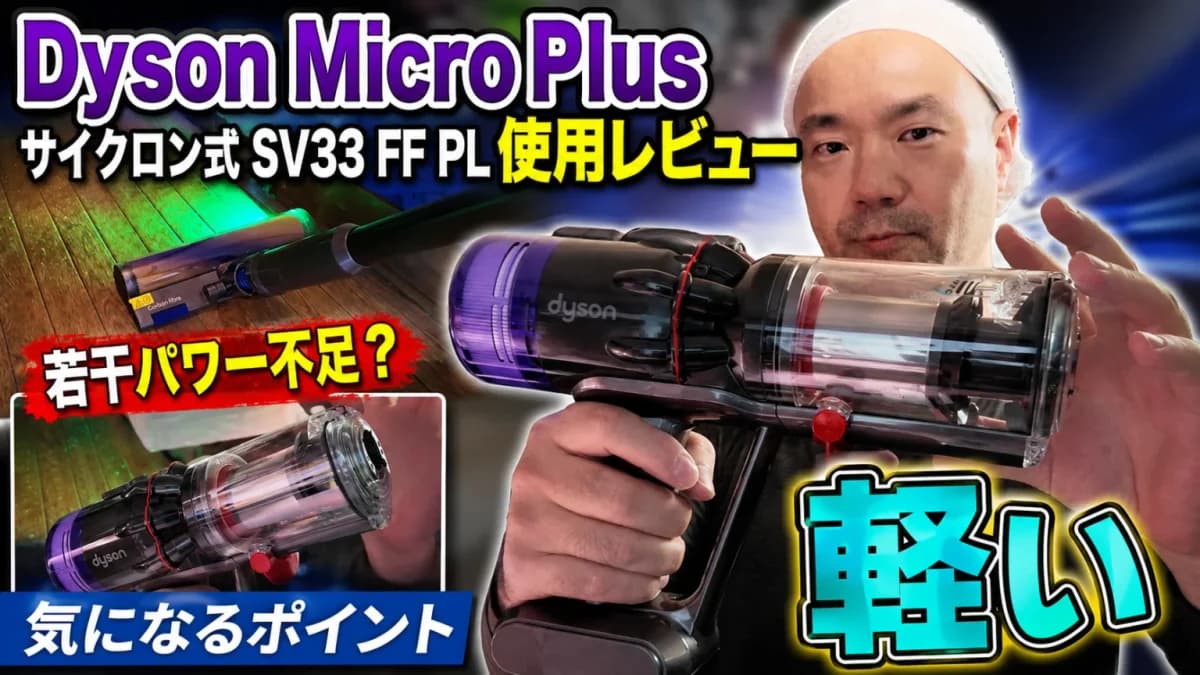
Stick-type vacuums, which carry the battery and motor right in your hand, are structurally prone to being heavy. Even as manufacturers competed to cut weight, getting the body alone under 1kg remained a "magic line" for ages. And now Dyson has thrown its lightest model ever into the ring: the "Dyson Micro Plus (SV33 FF PL)." Body weight? A mere 0.94kg or so. At last, they've broken the 1kg barrier.
As a gadget lover, the question of "how did they make it lighter" is a hundred times more interesting than the numbers on the spec sheet. Today, let's peek inside, grinning the whole way.
0.94kg—Just How Light Is That, Really?
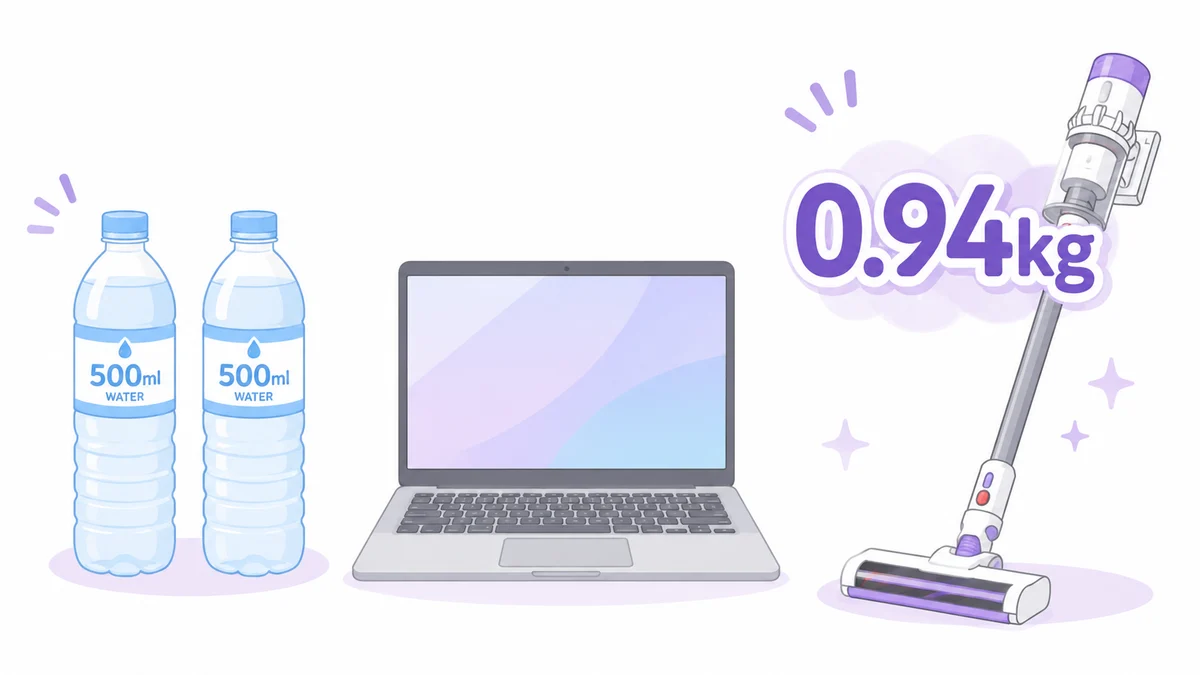
Numbers alone don't quite land, so let's swap them out for familiar objects.
- Two 500ml plastic bottles = about 1kg
- One laptop ≒ 1 to 1.4kg
- The Micro Plus body = 0.94kg
In other words, it's light enough to lift with one hand and clean dust on top of a shelf or the gaps in your car seats without your arm trembling. The previous-generation lightweight Dyson weighed about 1.30kg, so this is a reduction of roughly 360g.
360g sounds like "just one can of juice," but 360g while you're cleaning with your arm stretched overhead feels like more than double that. At cleaning's final boss—"around the ventilation fan near the ceiling" or "on top of the curtain rail"—this difference is decisive. Since you finish before arm fatigue builds up, your hand moves before you even think "what a hassle." Lightness translates directly into how often you clean.
The True Identity of the Lightness Was "Subtraction of Materials"
Here's the most delicious part from a gadget perspective.
This time, Dyson changed the extension pipe material from aluminum to resin (a PVC-based material). This is the star of the weight reduction.
What's fascinating is that this isn't a story of "adding some amazing new material"—they made it lighter through "subtraction," not "addition." Rather than lavishing it with high-performance carbon or special alloys, they simplified the structure and shaved off wasted weight. Technological progress tends to lean toward piling things on, but what really works is often subtraction. The same evolutionary context in which phones competed on thinness and laptops on lightness has now arrived for vacuum cleaners.
Of course, there are trade-offs. For those who cherish the "cool, rigid feel" unique to metal pipes, the lightness of resin may feel a touch lacking. This is entirely a matter of taste. But viewed as "a tool you grab quickly every day," lightness is justice. It's a clear design decision to go after frequency of use over the desire to possess.
The Quietly Effective "Green LED"
Debris Visualization
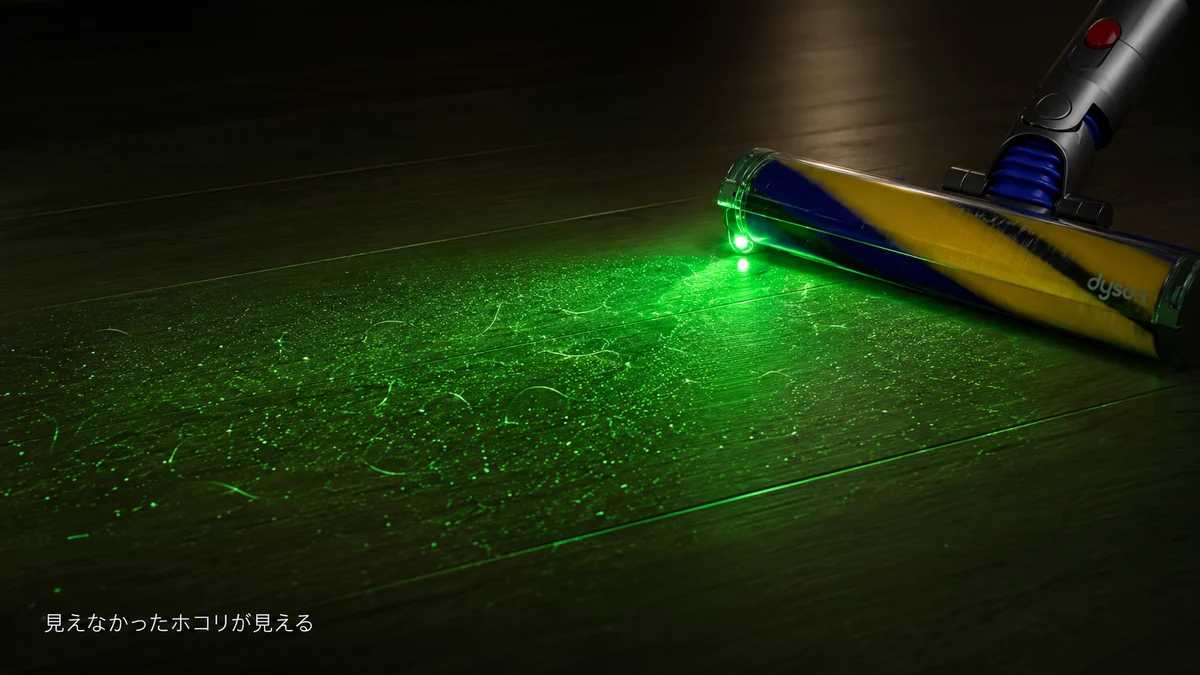
It looks like a bit player on the spec sheet, but when you actually use it, your rating skyrockets: the green LED light.
When it illuminates the area in front of the head with green light, fine dust and hair lurking on the wooden floor stand out clearly as shadows. It's that feature that lets you feel mildly despairing—"there was still this much left on a floor I thought I'd already cleaned…"
Why green, and not white or blue? It's because the human eye is most sensitive to green wavelengths, making it easier to perceive the contrast of fine bumps and debris. Even with a single light, there's solid reasoning behind it. The accumulation of these "small optimal solutions" is what makes the Dyson brand interesting. Once it's visualized, people can't help but want to do "one more pass." It's a humble but effective trick that turns cleaning from a "chore" into a "game."
Just Press the Red Lever for "One-Motion Trash Disposal"
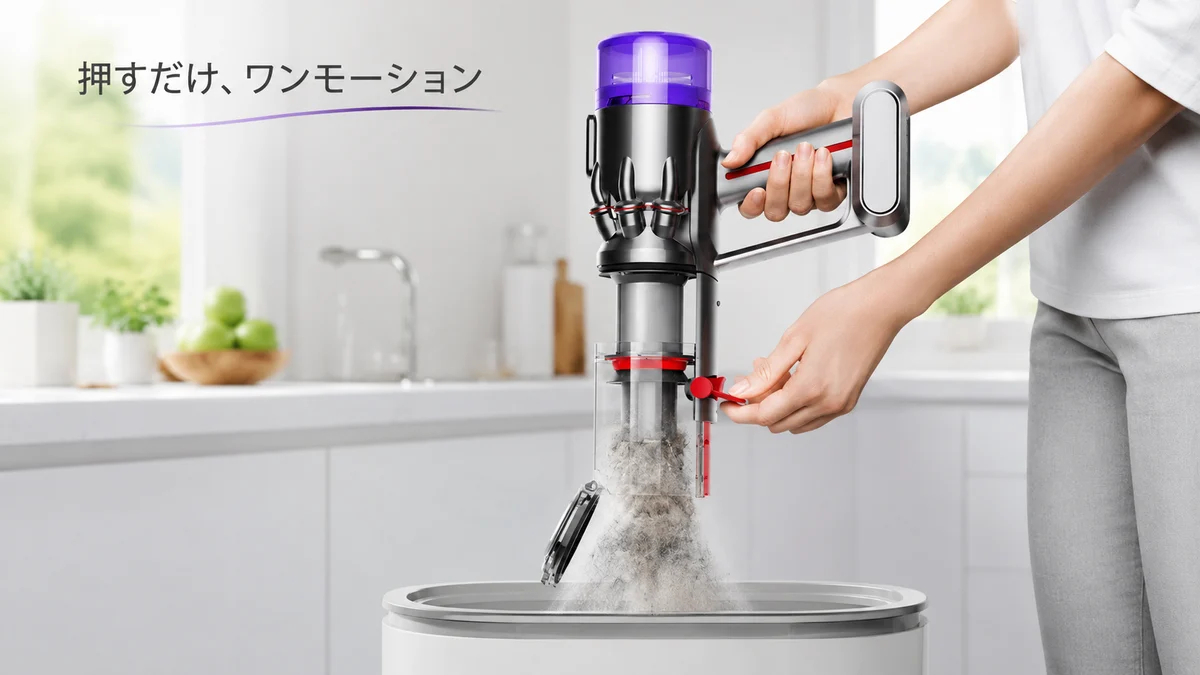
Dyson is famous for its structure that keeps your hands clean when emptying trash. The Micro Plus inherits this tradition: push the red lever on the body firmly and the bottom of the dust cup pops open, dropping all the trash at once in "one motion."
Hold it over the trash bin and press the lever. That's it. You never touch the filter, and the dust kicked up is kept to a minimum. This "satisfying to empty" experience design quietly supports your motivation to clean. A tool is only worth using continuously when it has a mechanism that makes you want to keep using it. If emptying it is a pain, you end up letting the trash pile up and the suction power drops—and this structure cuts off that negative loop.
Light Doesn't Mean Weak
"Is it really that light and still sucks properly?"—I think this is the point gadget lovers care about most.
This is where Dyson's true strength lies: the cyclone technology the company has honed over many years is fully carried over to this lightest model. What was shaved off for weight reduction was the "weight of the pipe," not the "suction mechanism." For everyday floor cleaning—dust on wood floors, hair on carpets, breadcrumbs on the table—it sucks them up nimbly.
Of course, if your use case is blasting through the whole house at high power or running it continuously with a large-capacity dust bin, that's the domain of the higher-end models. The Micro Plus is, after all, a device optimized for "using it hard every day thanks to its lightness." Rather than piling performance on in all directions, it narrows the use case and sharpens its edge. This decisiveness actually makes it more appealing as a gadget.
To Be Honest, a Few Points That Bug Me
Lavishing only praise wouldn't be fair, so let me leave you with some "caveats" worth knowing before you buy.
(1) The dedicated mini nozzle is in short supply The genuine mini-brush nozzle that shines on sofas, in cars, and in shelf gaps is chronically out of stock, perhaps because of its popularity. To avoid the "I can't get that handy nozzle!" situation after buying the unit, it's wise to secure stock early if you spot it.
(2) A storage stand isn't included as standard On the flip side of being lightweight and compact, a stand for upright storage may not come included by default. Even if a wall-mount bracket is provided, anyone who wants to secure a place to set it down should consider preparing a separate stand.
Both are matters of "how to arrange the surroundings," not "the quality of the unit." Conversely, that means the completeness of the unit itself is guaranteed.
The Price Is About 37,000 Yen—Is the Lightness Worth Paying For?
The price you're curious about is around 37,000 yen. It's by no means cheap, but in an era when Dyson's flagship class approaches 100,000 yen, offering the sharp value of "lightest ever" at this price is strategic.
For those who want high power and large capacity, there are higher-end models. But for someone who:
- Mainly lives in a studio or a small-to-medium room
- Just wants to clean quickly every day, stress-free
- Wants to reduce the burden on their arms and wrists
—the Micro Plus's 0.94kg hits home not as "a number on a spec sheet" but as "a daily physical sensation."
Conclusion: Lightness Is the Most-Used Performance
Not suction power, not battery life, but a single-point breakthrough called "lightness"—that's how the Dyson Micro Plus broke the 1kg barrier.
The subtractive design of swapping aluminum for resin, the small optimal solution of a green LED, the press-only trash disposal. Each one isn't flashy, but combined, they make "a tool you'll want to use every day." As both a spec geek and a person living daily life, this is a device that genuinely made me nod in approval.
No matter how high-performance it is, a light vacuum you reach for right away will, in the end, clean your room best—better than a heavy one tucked away. I never thought the day would come when I'd be charmed by a vacuum cleaner, but maybe the fun of gadgets dwells precisely within these humble evolutions.