

Anthropic of the US has made an announcement that shakes the conventional wisdom of the AI industry. On June 12, 2026, acting on an order from the US government, the company immediately suspended worldwide access to its top-tier AI model Claude Fable 5 and its researcher-oriented Claude Mythos 5. Just days after launch, the "most powerful model" suddenly became unusable — an extraordinary turn of events.
And this time, while complying with the government's order, Anthropic openly objected, saying it "cannot agree with this measure." An AI model being regulated in the name of "national security," and a company pushing back against it — this is a symbolic episode showing that AI has begun to be treated as a "strategic asset" on par with semiconductors and supercomputers. In this article, we first lay out the facts, then dig into our own view as operators (AIU), the lens of military diversion, and how much we should expect going forward.
What Happened — Sorting Out the Facts

According to Anthropic's official statement, the US government issued an export control directive on the grounds of its "national security authority." The substance: a halt to access to Fable 5 and Mythos 5 by all foreign nationals, whether inside or outside the United States. The scope even includes the foreign-national employees who work at Anthropic.
Because it is technically difficult to filter and block access by nationality alone, the company had no choice but to disable both models for all customers at once in order to ensure compliance with the law. Other models, such as Opus 4.8, are unaffected.
The directive arrived at 5:21 p.m. US Eastern Time on June 12. The document reportedly did not state any specific national security concern. As the company understands it, the government believes it has identified a "jailbreak" technique that circumvents Fable 5's safeguards.
What Is the "Jailbreak"
the Government Took Issue With
A jailbreak is a technique that slips past an AI's safety mechanisms to extract answers that would normally be refused.
According to Anthropic, all the government has shown so far is verbal evidence only, the substance of which it describes as a "narrow, non-universal potential jailbreak." Specifically, it involves having the model read a particular codebase (a body of source code), find a software flaw, and fix it. The company understands that one potential jailbreak was shared with the government.
After examining the report believed to underpin the directive, Anthropic counters that "the capability level shown there is widely available in other companies' models, including OpenAI's GPT-5.5, and is used daily by the defenders who protect systems." In other words, it argues this is a "commonplace capability" useful for both attack and defense — Fable 5 is not uniquely dangerous. The company says it will share more details within the next 24 hours.
One thing worth keeping in mind here is the difference between a "non-universal" and a "universal" jailbreak. The former is a "narrow" loophole that can extract certain information only in specific situations and for specific prompts; the latter refers to a "fatal" loophole that broadly neutralizes the model's safety mechanisms. To summarize Anthropic's argument: "What was found is a narrow loophole, the same thing can be done with other companies' models, and no one has yet found a fatal universal one" — hence the implication that this instant cutoff may be too heavy-handed relative to the actual risk.
Anthropic's Rebuttal — The Strength of Its Safeguards
Anthropic shows strong confidence in its own safety design. To sum up the key points:
- Before launch, working with the US government, the UK AISI (AI Safety Institute), multiple third-party organizations, and internal teams, it subjected the safeguards to red-teaming (verification by attackers) over a cumulative thousands of hours
- As a result, it confirmed that Fable's safeguards are "substantially stronger than any model previously deployed"
- A "universal jailbreak" that unlocks a broad range of capabilities all at once has still not been discovered by anyone
- If anything, some users complain that the safeguards are "too strong," i.e., excessive
Frankly acknowledging that perfect resistance is currently impossible for any model, the company adopts a "defense in depth" strategy. It designs jailbreaks to be "narrowly confined" or "costly to create," and uses continuous monitoring to detect and block them quickly. It also imposes a 30-day retention of usage data, it says, in order to study and mitigate attacks.
Anthropic's "Clear Objection"
— Why It Opposes a Recall
The most notable point in this statement is that, even while complying with the directive, Anthropic objected head-on.
The company stated plainly that it "does not believe a commercial model offered to hundreds of millions of people should be recalled just because a narrow potential jailbreak was found." It then warned that "if this standard were applied across the industry, the rollout of new models by every frontier (cutting-edge) model provider would effectively all grind to a halt."
Anthropic has long held the position that "we agree the government should have the authority to stop unsafe deployments." But that, it says, should be done through a legal process that is transparent, fair, clear, and grounded in technical fact. The core of its criticism is that this measure does not follow that principle.
Finally, the company apologized for the disruption to customers and concluded, "We believe this is a misunderstanding, and we are working to restore access as soon as possible." The fact that it chose not the binary of "comply or refuse" but rather "comply while openly objecting" reveals how deep the roots of this issue run.
AIU's View — Why "Once Again"
From here, let us state our view as operators (AIU).
What stands out most is the "gap in how dangerous each side estimates this to be" between the government and Anthropic. Taking Anthropic's account at face value, the technique in question is no more than "minor code diagnosis that other companies' models can also do and that defenders use routinely." And yet, in the name of national security, the most powerful model was cut off the same day. What does this gap mean?
One possibility is that what the government is looking at is not "the present real harm" but "the very fact that intelligence of this level falls into anyone's hands worldwide." Once an AI's capabilities cross a certain line, even if today's misuse examples are minor, there is no going back once it is distributed. That is precisely why it acted in the context of "halting access by foreign nationals" — that is, technology leakage and export control. Read that way, even the thinness of the explanation makes sense.
We deliberately wrote "once again" because this looks like the culmination of a series of moves treating AI as a "strategic asset." Following export controls on semiconductors, supercomputers, and GPUs, at last "the model's intelligence itself" has been named and regulated. AI is clearly beginning to be positioned as a piece on the board that sways the balance of power between nations.
The Lens of Military Diversion
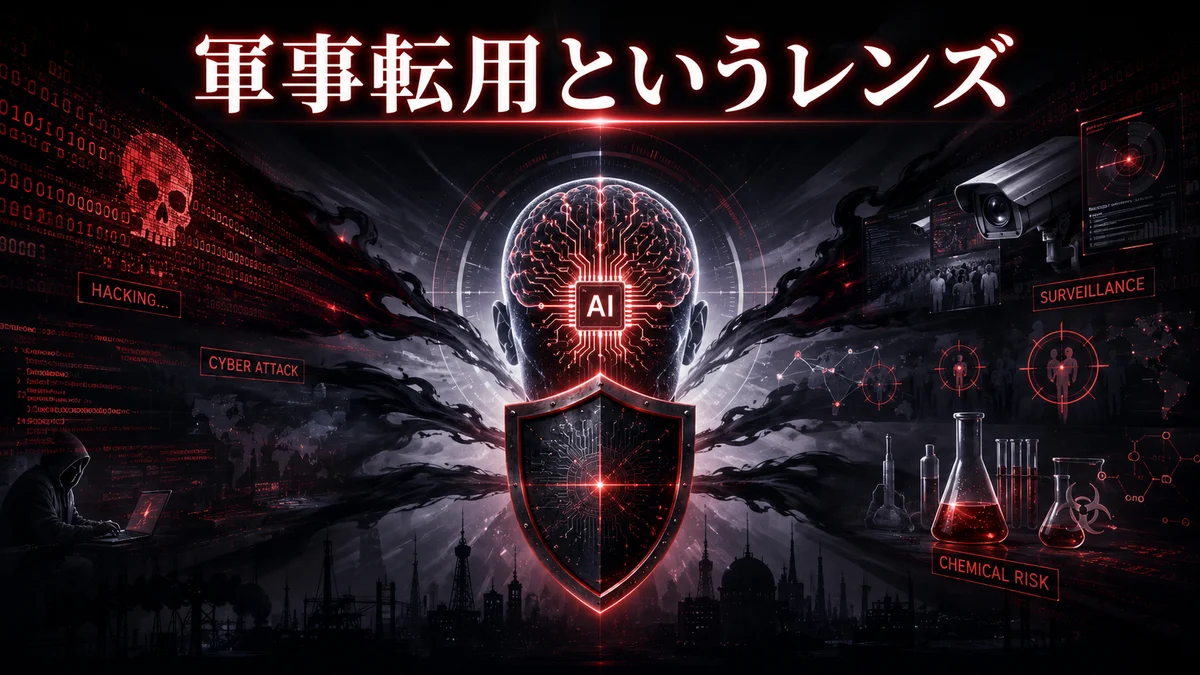
Behind the words "national security," there is, naturally, wariness toward "military diversion."
If the top-tier model is truly seen as dangerous, it is likely not for "minor bug-hunting" but for uses further down the line. Cyber-weaponization — autonomously discovering vulnerabilities and writing attack code — assistance in synthesizing dangerous knowledge in the biological and chemical domains, and support for intelligence and surveillance that analyzes vast amounts of information to narrow down targets. As long as Fable 5's biggest selling point is that it "can autonomously carry long, complex tasks through to the end," that power is continuous with the automation of attacks.
The irony is that Anthropic itself had boasted a safeguard that "automatically falls back to Opus 4.8 (taking over the response) in high-risk domains." Even so, the government went ahead with the cutoff. This is also a cold message that "the state will not be reassured by corporate self-regulation alone." The more AI's military potential becomes real, the more quietly the reins once held by developer companies shift to the government's side. The thoroughness of "even foreign-national employees are covered" is symbolic of that trend.
Impact on Users and Japan
Let us touch on the practical side too. Because users and companies in Japan fall under the "foreign nationals" referred to here, Fable 5 and Mythos 5 become unusable. However, other models such as Opus 4.8 remain available, and for many general uses the real harm is limited. The problem lies, rather, in the precedent now set that "the most powerful model can suddenly become unusable one day, with no clear advance notice."
The more an organization has fully depended on a specific model for its work, the more vulnerable it is to this shock. If you place AI at the core of your business, "preparing for diversification" — deciding first- and second-choice models for each use, managing prompts and evaluation criteria in a model-agnostic form, and periodically checking changes in pricing and terms of service — is becoming not a luxury but an essential operating discipline.
In addition, regulation on national-security grounds is, by its nature, hard for outsiders to predict in terms of "when and to what extent it will spread." Even if it is only Fable 5 and Mythos 5 today, the possibility cannot be denied that it will spill over to other models or other features tomorrow. That is exactly why the mindset of diversification — not letting one company or one model hold your business's lifeline — becomes ever more effective. The fact that MiteMite.net secures multiple paths (fallbacks) for image generation and article AI is precisely a preparation against this kind of uncertainty.
How Much to Expect — What This Cutoff Signals
So how should we take this event positively? Our (operator's) read is twofold.
One is that it is proof that AI's capabilities have reached the stage where "the state seriously moves to wall it off." The very fact that it was cut off serves as paradoxical testimony that the capabilities of Fable 5 and Mythos 5 are the real thing. Strong enough to be feared — viewed that way, expectations for where this technology is heading actually rise.
The other is expectation for rule-making. A state where "the directive's basis is not shown in writing" and "the company's verification and the government's judgment do not mesh" benefits no one in the long run. Fittingly, the very "transparent, fair, clear, technically-fact-based process" that Anthropic itself called for is an indispensable condition for export control in the AI era. This incident sharply drives home that building such a framework is an urgent task.
Summary
- On June 12, 2026, in response to a US government export control directive, Anthropic immediately suspended Fable 5 and Mythos 5 worldwide
- The scope is "all foreign nationals," so effectively all customers are unable to use them. Other models like Opus 4.8 are unaffected
- The government's concern is jailbreaking, but Anthropic counters that it is "a minor capability that other companies can also do and that defenders use daily"
- Anthropic complied with the directive while clearly objecting that "recalling a commercial model used by hundreds of millions is unjust" and "the rollout across the entire industry would halt"
- In the background is the state's logic of regarding AI as a "strategic asset" and being wary of military diversion. Building transparent rules is the next challenge
We may be witnessing, right now, the turning point at which AI changes from a "convenient tool" into a "strategic technology managed by the state." We will keep a close watch on further reports and on how both Anthropic and the government respond.