

⏱️ This story takes about 8 minutes to read.
The Morning the Translator Learned Cat
Right now, the fusion of AI and translation technology is accelerating. The accuracy of real-time multilingual translation apps improved dramatically in 2024, and as Google Translate and DeepL keep expanding the languages they support, voices in certain developer communities have started—half-jokingly—to say, "Next up is animal language."
Of course, a cat-language translator doesn't actually exist yet.
But—what if it did?
That little one curled up beside you—what is she thinking? When she gave a thin little cry while gazing out the window, when she sat down in front of her food bowl and refused to budge, when she suddenly pawed at your face in the middle of the night.
I always wanted to know.
Meeting the Translator, and My Hesitation
I got the device one autumn evening.
Let me say upfront that this is a story within fiction. But everything I thought as I actually sat down in front of my beloved cat Mugi—a brown tabby male, estimated to be 13 years old—and gazed into his eyes while writing this story, is all true.
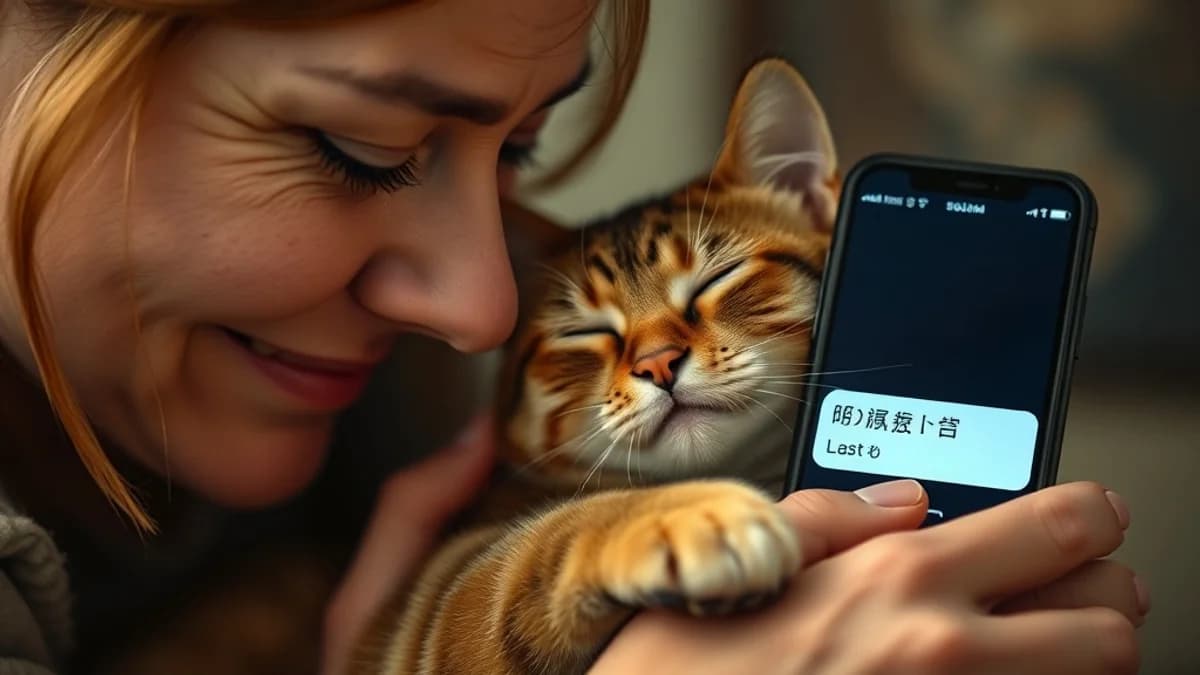
The "I" in the story held a thin terminal, similar to a smartphone, in my hand. On the screen was a small microphone icon and the display "Animal Mode: Felis catus (Cat)." In the story's setup, it was developed by a research team at the University of Tokyo—a system that trained an AI on animals' vocalization patterns and behavioral data to convert their emotions and intentions into Japanese text.
To be honest, I was afraid to use it.
Part of me wanted to know, and part of me didn't. I think you might have those kinds of feelings too. That peculiar fear of hearing the true feelings of someone precious to you.
Mugi was sitting on the engawa (the wooden veranda), watching the setting sun. The orange light softly lit up his stripes, and his outline somehow looked almost sacred. Thirteen years. The memories of the thirteen years I'd spent with him seemed to overlap with his profile.
I gently pointed the device's microphone toward him.
Mugi let out a small cry.
"Mrrr."
Just one sound. That was all. But after a few seconds of processing, these words appeared on the screen:
"The sunlight feels nice."
Our First Conversation—Cats Are More Philosophical Than I Thought
I couldn't help but laugh.
Oh, is that all? But at the same time, a gentle warmth spread through my chest. In this very moment, he was simply, purely feeling "nice." He knew that was enough.
I wanted to ask him more.
"Mugi, is your food good?"
When I spoke, he slowly turned to look at me. His golden eyes caught mine. Then he faced forward again and gave a short cry.
"It's okay. But I liked yesterday's better."
"Yesterday... you mean the chicken one."
Personally, this was the moment that surprised me most. The fact that a cat has a sense of time like "yesterday." That he compares things and decides what he likes and dislikes. It might be an obvious thing, but when it appeared before my eyes as text, I realized all over again that he truly is a "thinking being."
After a moment of silence, Mugi cried on his own. This time in a slightly longer voice.
"You haven't been sleeping well lately."
I caught my breath.
It was true—for the past few weeks, I'd been waking up over and over in the middle of the night from work-related stress. Mugi had known. Every time I tossed and turned in bed late at night, he would quietly come close and press himself against my back. So that hadn't been a coincidence.
"That's why I stay near you."
The moment I saw that single line appear on the screen, my eyes grew hot.
The "Cat's Time"
He Told Me About
As our conversation continued, Mugi told me, little by little, about his world.
For a cat, the flow of time is different from ours. They seem to live by the density of "now" more than by "the past" or "the future." What Mugi said was something like this:
"You humans worry too much about things that haven't come yet."
I had no words to reply.
I felt like a 13-year-old cat had struck at the very heart of life. I was always letting my mind be occupied by tomorrow's deadline, next month's budget, next year's plans—and I hadn't really been seeing how beautiful this evening sun on the engawa was, right now.
"This light only exists today. Tomorrow's light will be different."
Mugi stood up and gave a big stretch. His spine arched supplely like a bow, and then he plopped back down to sit. That whole sequence of movements was, for some reason, terribly dear to me.
I think there's actually an enormous amount we can learn from cats. Mindfulness, focusing on this present moment—humans go out of their way to learn these things from books, but cats practice them naturally, from birth.
And Then, the Final Message
As the sun began to set, Mugi stood up from the engawa and climbed onto my lap.
His body had grown a little heavier over thirteen years. But it was warm as ever. He curled up and narrowed his eyes. A purring vibration came through my lap.
I thought there was no need to say anything. Just being like this was enough.
But he cried once more.
It was a low, quiet voice I'd never heard before.
The hand holding the translator trembled a little.
"I may not have much longer."
It felt like my heart stopped.
Lately, Mugi's appetite had dropped a little. The vet had said, "It's probably just his age," but somewhere inside, I had been bracing myself. Or I'd thought I had. But when the words actually came from his mouth—well, even if it was through a translator—I couldn't stop the tears.
"But please don't be sad."
The screen blurred.
"I'm so glad I got to be by your side."
On my lap, Mugi kept purring, his eyes closed. The vibration now felt like a comfort.
"Thank you for the food. Thank you for the warm place. Thank you for calling my name."
I set down the smartphone and gently cupped Mugi in both hands. No words would come. I just wanted to feel his warmth for as long as I could.
After a while, Mugi gave one more short cry.
"Don't cry. I'm here. Right now, I'm here."
What the Translator Taught Me
This is fiction.
A machine that translates cat language doesn't exist, at least for now. Mugi never actually spoke these words.
But the fact that I cried while writing this story is true.
The real Mugi is on the engawa again today, watching the setting sun. The age of 13 is said to correspond to 68 in human years for a cat (according to the conversion chart of the International Society of Feline Medicine). He's a senior cat now. In my head, I know that someday a goodbye will come.
But there's something I realized while writing this story.
Even without a translator, he had been speaking to me all along.
When he climbs onto my lap, when he presses against my back late at night, when he gazes steadily at me in front of his food bowl. Even without words, he had always been saying, "I'm here with you." Maybe we had simply forgotten to receive it.
Living with a cat means continuing a wordless dialogue—at least, that's what I personally believe. And that dialogue sometimes reaches the heart more deeply than words ever could.
What Is Your Cat Saying Right Now?
If you, too, have a cat who stays by your side—tonight, try talking to her without a translator.
It can be "How was your day?" or "Was your food good?" or just "I love you."
She's surely listening to your voice. And with something other than words, she'll answer you, truly.
What Mugi taught me—"to live in this present moment"—is, I think, this very time spent together with a cat. Even without a translator, you have long since been receiving your cat's words.
Tonight, give your beloved cat a tight hug.
Because that is the most certain translation of all. 🐾
To be continued in Episode 4—"What I Saw Through the Translator: What Cats Are Truly Afraid Of"